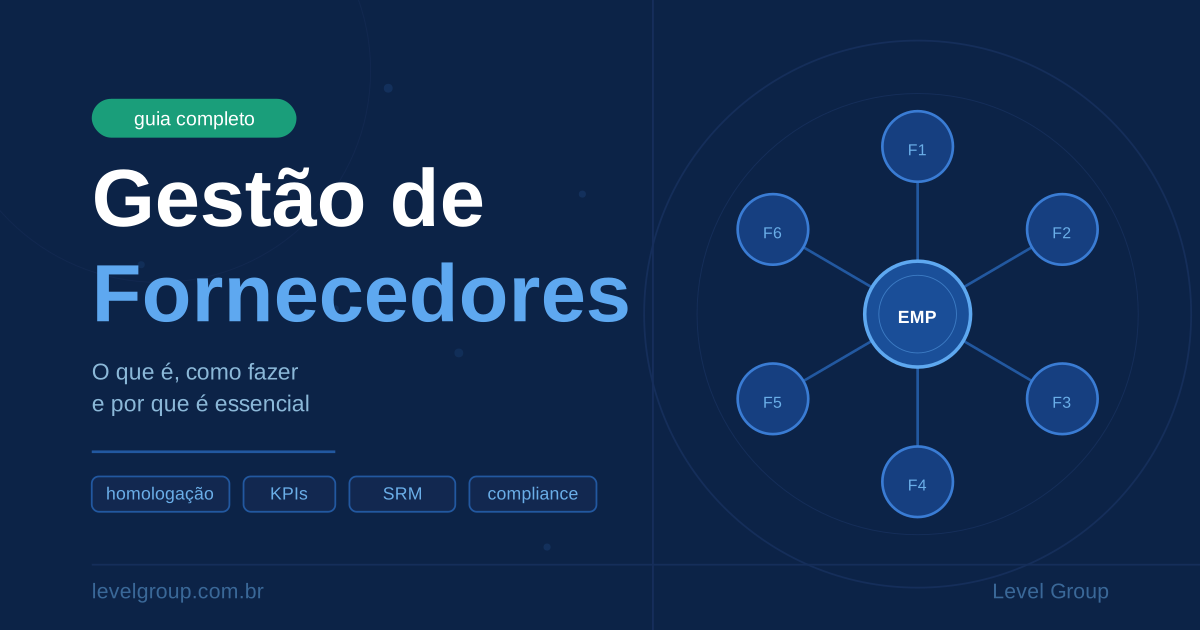
Supplier management is the set of processes a company adopts to identify, select, hire, monitor, and evaluate partners providing products or services to its operation. The goal is to ensure quality, legal compliance, and risk reduction across the entire supply chain.
Every organization depends on suppliers to operate—from raw materials to outsourced services. However, hiring without monitoring can lead to labor liabilities, delays, quality failures, and even operational shutdowns. Therefore, supplier management has ceased to be an operational task and has become a strategic pillar in procurement and supply chain.
In this comprehensive guide, you will understand what supplier management is, the stages of the process, how to build a risk matrix, which indicators to monitor, and how technology is transforming this field.
What is supplier management?
Supplier management—also known as SRM (Supplier Relationship Management)—is the discipline that manages the end-to-end lifecycle of the relationship between a company and its suppliers: from sourcing and onboarding, through contracting and performance monitoring, to renewal or termination of the engagement.
A supplier is any company or legal entity that regularly supplies your operation, whether with raw materials, supplies, general services, technical services, outsourced labor, or any other delivery that supports your company's activities.
Contrary to what many think, supplier management is not synonymous with procurement management. Procurement focuses on the transaction (what to buy, from whom, and at what price). Supplier management focuses on the relationship, risk, and the partner's performance over time.
Why is supplier management strategic?
A survey by Deloitte showed that 31% of Brazilian companies cite having suppliers aligned with the hiring company's values and processes as a challenge. Furthermore, gaps in third-party oversight are one of the main sources of labor liabilities—a risk that falls directly on the contracting company.
More than just avoiding issues, efficient supplier management delivers concrete benefits:
- Cost reduction through more strategic negotiations and waste elimination
- Increased delivery quality through continuous monitoring of SLAs and indicators
- Legal compliance and reduction of labor, tax, and social security liabilities
- Greater operational resilience with qualified and risk-assessed suppliers
- Data-driven decisions for supplier renewal, replacement, or development
Types of suppliers: how to classify them
Efficient management does not exist without segmentation. Treating all suppliers equally leads to inefficiency and wasted resources. The most widely used market classification considers two axes: criticality (business impact) and complexity (difficulty of substitution).
Strategic suppliers
High criticality and high complexity of substitution. Typically responsible for core operational supplies or services. They require long-term contracts, strict SLAs, and frequent monitoring.
Leveraged suppliers
High criticality, but easy to substitute in the market. Here, the hiring company's bargaining power is greater. They are natural candidates for competitive bidding and e-auctions.
Bottleneck or critical suppliers
Low criticality for daily operations, but difficult to replace when needed—such as niche suppliers or those with specific certifications. They require attention in contingency planning.
Non-critical suppliers
Low criticality and easy substitution. Managed more simply, with standardized onboarding processes and minimal need for continuous monitoring.
The 5 stages of supplier management
- Mapping and identification
Before any procurement takes place, map the company's needs and identify which suppliers in the market can fulfill them. Define objective criteria: quality, price, lead time, location, certifications, track record, and alignment with ESG and compliance policies.
- Onboarding and Qualification
Onboarding is the process of qualifying a supplier prior to contracting. It involves collecting and validating technical, financial, tax, environmental, and labor documents. Companies with many contractors require automated onboarding systems to handle the volume without creating compliance gaps.
- Contracting and integration
Once the supplier is approved, formalize terms in a contract: scope, SLAs, penalties, labor responsibilities, and compliance clauses. For labor suppliers, include employee documentation requirements and access protocols.
- Continuous monitoring and periodic evaluation
Management does not end with contract signing. Continuous monitoring verifies whether SLAs are being met, documentation is up to date, there are no tax or labor issues, and performance meets expectations. The frequency varies according to the supplier's risk profile.
- Development or offboarding
Based on monitoring results, decide whether to: develop the supplier (training, improvement plans), renew with contractual adjustments, or legally and safely offboard the relationship. Strategic suppliers warrant a long-term development plan.
Criticality matrix: how to prioritize management efforts
With dozens or hundreds of active suppliers, dedicating the same level of attention to all is impossible. The criticality matrix resolves this by crossing two criteria for each supplier:
- Operational impact (high / low): how much does this supplier's failure disrupt the business?
- Ease of substitution (difficult / easy): are there alternatives in the market?
The result is a 2×2 matrix indicating where to focus management resources: strategic suppliers at the top of the priority list, non-critical suppliers handled through streamlined processes.
Essential KPIs for supplier evaluation
Without metrics, supplier evaluation becomes subjective. The most common indicators in the market are:
- OTIF (On Time In Full): percentage of deliveries on time and in full
- Document compliance rate: proportion of valid documents compared to the total required
- Rework or return rate: delivery quality
- Supplier NPS: supplier satisfaction with the business relationship
- Average onboarding time: efficiency of the new supplier onboarding process
- Identified labor liability rate: percentage of irregularities detected during monitoring
Define targets for each KPI according to the supplier's profile and review them periodically. Strategic suppliers should have quarterly or semi-annual evaluation meetings.
Supplier management and SRM: what is the difference?
SRM (Supplier Relationship Management) is a broader concept that encompasses supplier management. While supplier management focuses on operational processes—onboarding, monitoring, evaluating—SRM also includes the strategic dimension of the relationship: collaborative development, joint innovation, value alignment, and building long-term partnerships.
In practice, more mature companies evolve from transactional management (where the supplier is merely a service provider) to an SRM approach (where the supplier is a strategic partner with whom value is co-created).
Technology in supplier management
Digital transformation has profoundly changed the way companies manage their suppliers. Processes that relied on spreadsheets, emails, and physical files have become automated by SRM platforms powered by artificial intelligence.
The main features that technology delivers in this area:
- Automated document validation via AI—reducing human error and processing time
- Expiration alerts for documents and legal obligations
- Real-time dashboards providing a compliance overview by supplier, contract, and business unit
- Supplier portal for submitting and updating documentation
- Automated cross-referencing of labor data (timesheets, ASO, PCMSO, CCT)
- ERP integration for a unified view of procurement and payments
ESG and compliance in the supply chain
The ESG agenda has reached supplier management. Large corporations and international groups now require their suppliers to demonstrate environmental, social, and governance practices—ranging from occupational safety policies to environmental certifications and financial transparency.
Integrating ESG criteria into supplier onboarding and evaluation is a growing necessity for companies seeking certifications, serving demanding corporate clients, or operating in regulated industries.
Most common challenges in supplier management
Even companies with well-structured processes face recurring difficulties:
- Supplier volume vs. monitoring capacity: the larger the base, the harder it is to maintain compliance without automation
- Reliance on spreadsheets and manual processes: increases the risk of human error and loses traceability
- Suppliers that cease operations or experience deteriorating financial health: without monitoring, the company only discovers this once the problem has already materialized
- Managing third-party labor: high turnover and document volume require robust validation processes
- Lack of standardization across units: companies with multiple plants or legal entities often have differing criteria, creating inconsistencies
Frequently asked questions about supplier management
What is supplier management?
Supplier management is the set of processes a company uses to identify, select, contract, monitor, and evaluate the partners supplying products or services for its operations. The goal is to ensure quality, legal compliance, and risk reduction across the supply chain.
What is the difference between supplier management and SRM?
Supplier management focuses on operational processes throughout the supplier lifecycle (onboarding, monitoring, evaluation). SRM (Supplier Relationship Management) is broader and includes the strategic dimension: partnership development, joint innovation, and long-term alignment.
What is supplier onboarding?
Supplier onboarding (or qualification) is the process of qualifying a supplier prior to contracting. It involves collecting and validating technical, economic-financial, tax, labor, and environmental documents to verify whether the supplier meets the hiring company's minimum requirements.
What are the key KPIs for supplier evaluation?
Key indicators include: OTIF (On-Time In-Full), document compliance rate, rework/return rate, average onboarding time, and identified labor liability rate. The choice of KPIs should reflect each supplier's risk profile.
How does AI help in supplier management?
Artificial intelligence automates document validation, issues preventive expiration alerts, cross-references labor and financial data in real time, and generates compliance overviews by supplier and contract—reducing manual effort and increasing control accuracy.
What risks does supplier management help avoid?
The primary risks mitigated are: labor and social security liabilities, administrative fines from the Ministry of Labor, operational shutdowns, loss of certifications, reputational damage to the hiring company, and reliance on financially distressed suppliers.
How Level Group can help
Level Group has nearly 20 years of experience in supplier management and has managed over 90,000 contractors for leading companies in Brazil. Speak with a specialist and receive a free evaluation of your company's current model.